Can rewriting a landing page around customer objections improve qualified enquiries?
A running experiment that rewrites one landing page around the doubts buyers actually raise, then compares the quality of enquiries before and after.
 By Jayaprakash DasMarketer, researcher and speaker
The LabEntry #004
Details
- Status
- Running
- Evidence
- Illustrative
- Format
- Before-and-after analysis
- Status
- Running
- Evidence
- Illustrative
- Reading time
- 7 min read
- First published
The question
Does a landing page rewritten around the objections customers actually raise produce more qualified enquiries than the current page?
Hypothesis
Answering the three most common objections on the page itself will increase the share of enquiries that are a good fit, even if the total number of enquiries stays the same or falls.
This is a sample entry that shows how an experiment looks. It will be replaced by a real one.
Many landing pages answer the questions the business wishes people asked. This experiment starts from the questions people do ask, usually just before they decide not to get in touch. The page in this sample is a hypothetical service page, and every step below describes how the test would be run. Nothing has been measured, and no result is reported.
Why this question
When a page gets visits but the enquiries are a poor fit, the usual fixes are more traffic or a new design. Both treat the problem as attention. The doubts a buyer carries to the page are a different problem: price, timing, whether the business has done this kind of work before, what happens after the first call. If the page does not answer them, two things happen. Some good-fit buyers leave without a word, and some poor-fit buyers enquire anyway, because nothing told them the service was not for them.
So the measure that matters here is not the number of enquiries. It is the share of enquiries that are a good fit. The total may stay the same or even fall, because the page should also help the wrong people decide not to enquire. That is part of the test, not a failure of it.
Setup
- The page. One service landing page. Its offer, price and traffic sources stay unchanged for the whole test, so the only thing that changes is how the page explains itself.
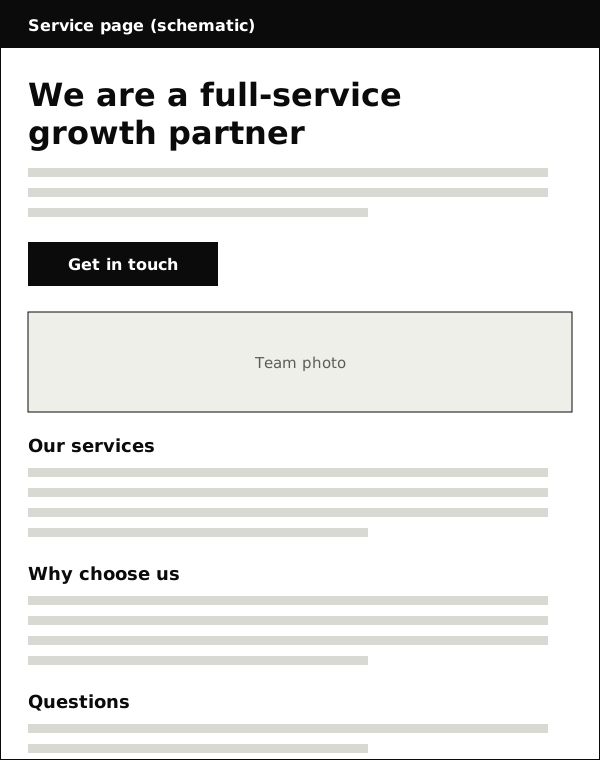
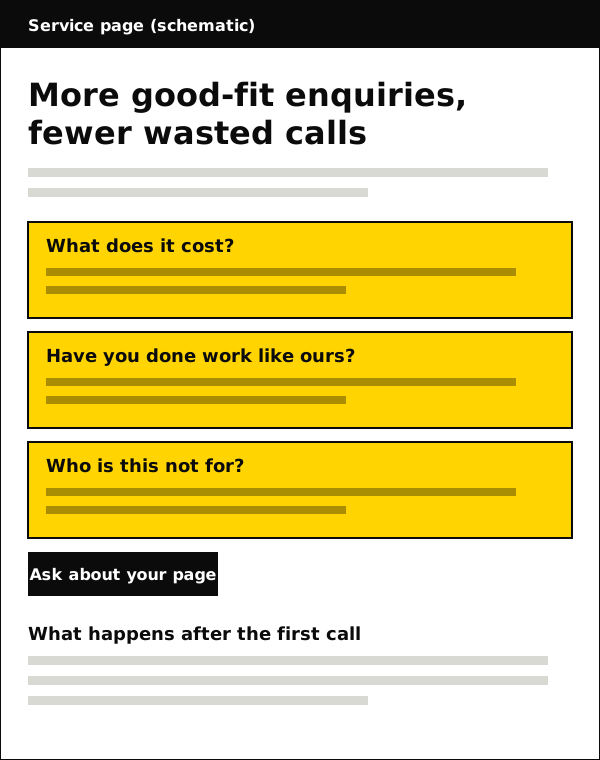
- The rewrite. The headline, the order of sections and the questions answered on the page change. Each of the three most common objections gets a plain answer close to where it would arise.
- What counts as qualified. Agreed in writing before the test starts: an enquiry that fits the budget range, the type of work offered and the timing.
- Comparison. A fixed period before the change against an equal period after it, with the dates written down in advance.
Step 1: Collect the objections in the customer’s words
The raw material is the last few months of enquiry emails, contact-form messages and notes from sales or discovery calls. For each one, every doubt, condition or question is copied out as close to the original wording as possible. “Do you work with businesses our size?” is kept as it is, not turned into “concern about fit”.
Three sources are worth keeping apart, because they reveal different things:
- Enquiries that became customers. Their questions show what a good-fit buyer needs answered before committing.
- Enquiries that did not. Their questions often show the doubt that ended the conversation.
- Reasons given for turning people down. These show what the page failed to tell poor-fit buyers before they wrote in.
Names, company details and anything else that identifies a person are removed before the notes are grouped. If an AI model helps with the grouping, it only sees the anonymised notes, and every group is checked by hand against the original wording.
Step 2: Group, count and choose three
Similar doubts are grouped under a short label, and each group is counted. A typical set of groups for a service business might be cost, time to results, relevant experience, what the process involves and what happens if it does not work. The counts matter less than the pattern, but they stop the loudest single conversation from setting the agenda.
The three most frequent groups shape the rewrite. Choosing three, not ten, keeps the change focused enough to learn from. If the page answered every possible doubt, it would be longer, slower to read and harder to judge afterwards.
Step 3: Write the answers where the doubt arises
Each objection gets an answer in plain words, placed where a reader would first feel the doubt. A question about price belongs near the description of what is included, not in a footnote. A question about relevant experience belongs next to the main claim, with a specific example rather than a general reassurance.
Three rules guide the answers:
- Answer, do not argue. A clear statement of what the service includes, costs or requires is more useful than a persuasive one.
- Be specific about who it is not for. One honest sentence saying when the service is the wrong choice does more for enquiry quality than any amount of praise.
- Keep proof next to the claim. A review, an example or a guarantee is placed beside the sentence it supports.
The headline is rewritten last, once the answers are clear. It should name the outcome for the buyer and, where possible, address the most common objection directly.
Step 4: Define qualified before anything goes live
The definition of a qualified enquiry is written down and dated before the new page is published. It names the budget range, the type of work and the timing that make an enquiry a good fit. The person who judges each enquiry applies the same definition to both periods.
Where possible, that person should not know which period an enquiry came from when judging it. In a small business that is rarely practical, so the next best thing is to judge each enquiry on the day it arrives, using the written definition, and to record the reason for every decision.
Baseline
The baseline is the current page over the period before the rewrite. Four figures are recorded:
| Measure | Before the rewrite | After the rewrite |
|---|---|---|
| Enquiries received | not measured yet | not measured yet |
| Share judged qualified | not measured yet | not measured yet |
| Most common reasons for turning people down | not recorded yet | not recorded yet |
| Visits to the page, by traffic source | not measured yet | not measured yet |
The baseline is recorded here before the new page goes live, so the comparison cannot be adjusted afterwards. Visits by traffic source are included because a change in where visitors come from could explain a change in enquiry quality on its own.
How the results will be read
The question is answered by the share of qualified enquiries, not the total. Before the test, three readings are written down:
- Supported if the share of qualified enquiries rises clearly and the mix of traffic sources stays roughly the same.
- Not supported if the share stays flat or falls.
- Inconclusive if the number of enquiries is too small to tell a real change from normal variation, or if something else changed at the same time, such as a new advertising campaign.
The comparison will be shown like this, with the share of qualified enquiries in each period side by side and the number of enquiries each share is based on. The numbers in this example are invented to show the layout.
| Period | Qualified |
|---|---|
| Before the rewrite | 30% |
| After the rewrite | 45% |
With a small business, inconclusive is a likely outcome. That is still worth knowing, and it will be reported as such. The reasons for turning people down are compared as well: if the most common reason changes, the page may be filtering differently even if the share has not moved yet.
Findings
The experiment is running and nothing has been measured yet. When it ends, this section will report the before and after figures side by side, how many enquiries each is based on, and whether the reasons for turning people down changed. If the share of qualified enquiries does not move, that result will be published too.
Limitations
- A before-and-after comparison is not a controlled test. Seasonality, a change in ad spend or a single referral can move the numbers on their own.
- Small businesses get few enquiries, so the sample is likely to be small and the result uncertain.
- Judging whether an enquiry is qualified involves human judgement, even with a written definition.
- The objections come from people who did enquire. People who left without a word may have had different doubts.
- Rewriting a page changes several things at once. If the result is positive, it will not show which answer did the work.
How to run this on your own page
The method does not need special tools. You need access to your enquiry and call notes, a few hours to group them, the ability to edit the page and a written definition of a good-fit enquiry. Run it for long enough to collect a meaningful number of enquiries in each period, and resist changing anything else on the page while it runs. The landing page diagnosis playbook covers the earlier question of whether the page is the problem at all.
Next experiment
If the share of qualified enquiries rises, the next step is a split test of the two pages at the same time, to rule out timing. If it does not, the next question is whether the objections were the right ones, which means interviewing people who visited the page but did not enquire.